What is an AI Agent? Understanding the Technology Behind MyAgentive
AI agents are autonomous software entities that perceive their environment, process information, and take actions to achieve specific goals. Learn how AI agents work and why they matter for personal productivity.
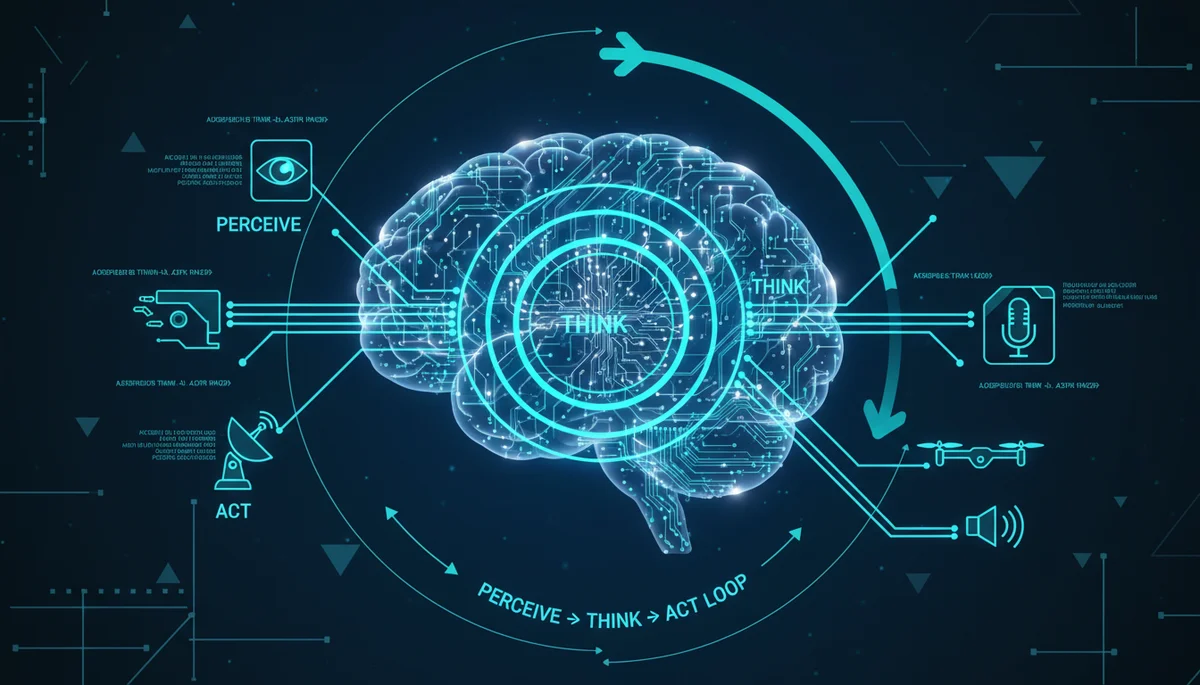
Artificial intelligence has evolved from science fiction into practical technology transforming how we work and make decisions. At the heart of this revolution lies the AI agent: an autonomous software entity that perceives its environment, processes information, and takes actions to achieve specific goals.
The Definition of an AI Agent
At its most fundamental level, an AI agent is an autonomous computational entity that perceives its environment through sensors or data inputs, processes this information using intelligent algorithms, and executes actions to achieve predetermined objectives without requiring constant human supervision.
Unlike traditional software programmes that follow rigid, predetermined instructions, AI agents possess the capacity to learn, adapt, and make independent decisions based on their observations and experiences.
AI agents possess four defining characteristics:
- Autonomy: Operating without direct human control
- Reactivity: Perceiving and responding to environmental changes
- Proactivity: Taking initiative toward goals rather than merely reacting
- Social ability: Interacting with other agents, systems, or humans
The intelligence within AI agents derives from machine learning, natural language processing, computer vision, and reasoning algorithms. These technologies enable pattern recognition, contextual understanding, outcome prediction, and continuous performance improvement.
Key Capabilities of AI Agents
Environmental Perception
AI agents continuously monitor their environment through sensors, data streams, APIs, and user interfaces. Advanced capabilities include computer vision, natural language understanding, and sensor fusion for comprehensive environmental awareness.
Intelligent Decision-Making
AI agents evaluate information against goals using rule-based systems, probabilistic reasoning, optimisation algorithms, and neural networks. Decision-making sophistication ranges from simple reflexes to complex strategic planning.
Learning and Continuous Improvement
Through machine learning, agents improve performance without explicit reprogramming. Supervised learning recognises patterns from examples, unsupervised learning discovers hidden structures, and reinforcement learning optimises behaviour through trial and error.
Natural Language Communication
NLP capabilities enable fluid human-agent interaction, including understanding context and intent, extracting information from text, generating appropriate responses, and maintaining conversational context.
Types of AI Agents
Understanding these types helps you appreciate what makes personal AI agents like MyAgentive special:
Simple Reflex Agents
Operate on condition-action rules without considering history. Examples include thermostats, spam filters, and basic chatbots. They excel in well-defined environments but struggle with context-dependent scenarios.
Model-Based Reflex Agents
Maintain internal environmental models, tracking unobservable aspects. Applications include autonomous vehicles tracking occluded objects and smart home systems remembering preferences.
Goal-Based Agents
Act to achieve specific objectives, evaluating action sequences. Examples include navigation systems, game-playing AI, and task scheduling systems requiring strategic planning.
Utility-Based Agents
Handle multiple objectives by assigning utility values to outcomes, enabling trade-off analysis. Applications include recommendation systems, resource allocation, and financial portfolio management.
Learning Agents
The most advanced type, incorporating learning mechanisms for continuous improvement. They adapt through experience, discovering better strategies. MyAgentive is a learning agent that gets smarter the more you use it.
How Do AI Agents Work?
AI agents function through a continuous “sense-think-act” cycle:
1. Perception
Agents gather environmental information through sensors, APIs, databases, and user inputs. Raw data undergoes preprocessing to extract features, filter noise, and identify patterns relevant to decision-making.
2. Knowledge Representation
Agents maintain internal representations of their environment, goals, and knowledge using symbolic representations (logical rules, ontologies) or subsymbolic representations (neural network weights, statistical models).
3. Reasoning and Decision-Making
The agent’s reasoning engine evaluates potential actions using rule-based reasoning, search algorithms, probabilistic reasoning, machine learning models, and optimisation algorithms.
4. Action Execution
Agents execute selected actions through APIs, database operations, user interfaces, or motor controls. Execution monitoring detects failures and triggers error recovery when needed.
5. Learning and Adaptation
Learning agents improve through feedback cycles: executing actions, observing outcomes, receiving feedback, updating internal models, and applying improvements to future decisions.
Real-World AI Agent Examples
Virtual Personal Assistants
Siri, Google Assistant, and Alexa exemplify AI agents serving millions daily. They understand voice commands, execute actions, and learn user preferences for personalised experiences.
Autonomous Vehicles
Self-driving cars use multiple sensors to perceive surroundings, plan safe routes, and execute precise vehicle control in real-time.
Customer Service Chatbots
Conversational agents handle enquiries using natural language processing, access knowledge bases, and maintain context throughout interactions.
Recommendation Engines
Netflix, Amazon, and Spotify employ AI agents analysing user behaviour to deliver personalised recommendations.
Personal AI Agents Like MyAgentive
This is where AI agents become truly personal. MyAgentive runs on a dedicated, single-tenant cloud server managed for you, connects to your tools (email, social media, file system), and executes tasks autonomously based on your instructions.
What Makes MyAgentive Different
Most AI agents are designed for businesses or specific platforms. MyAgentive is designed for you:
- Managed for you: runs on a dedicated, single-tenant cloud server in Australia
- Self-learning: discovers and adds new skills on command
- Multi-interface: access via the Web UI or the dedicated MyAgentive mobile app
- No third-party messaging: the app connects directly to your server, so your personal and customer data is never routed through a third-party chat platform like Telegram or WhatsApp, where you cannot control how it may be used
- 100% private: single-tenant, with your data kept in Australia (AWS Sydney)
- Extensible: add capabilities through Agentive skills
When you tell MyAgentive to post on social media and it does not know how, you can say “find that skill and add it yourself.” It will search its skill library, install the capability, and complete the task. Next time, it already knows.
The Future of Personal AI Agents
The age of AI agents has arrived, offering unprecedented opportunities for personal productivity. Understanding what an AI agent is marks just the beginning. Real value comes from actually using one to automate your digital life.
MyAgentive represents a new category: the personal AI agent. Not a chatbot. Not an assistant trapped in a corporate app. A true agent that runs on a dedicated, single-tenant server, respects your privacy, and works for you.
Ready to experience the power of a personal AI agent? Get started with MyAgentive today.
Frequently Asked Questions
What is an AI agent?
An AI agent is an autonomous software entity that perceives its environment through data inputs, processes that information using intelligent algorithms, and takes actions to achieve specific goals without constant human supervision. Unlike traditional software that follows rigid instructions, it can learn, adapt, and make independent decisions.
How is an AI agent different from regular software?
Traditional programmes follow fixed, predetermined instructions. An AI agent can perceive its environment, make decisions, learn from experience, and act toward a goal on its own, which lets it handle situations that were not explicitly scripted in advance.
What are the key capabilities of an AI agent?
AI agents share four defining traits: environmental perception, intelligent decision-making, learning and continuous improvement, and natural language communication. Together these let an agent understand a situation, decide what to do, improve over time, and interact in plain language.
What are the different types of AI agents?
AI agents range from simple reflex agents that respond to immediate inputs through to more advanced agents that model their environment, plan ahead, and pursue goals. The right type depends on how complex the task and environment are.
Is an AI agent the same as a chatbot?
No. A chatbot mainly generates responses in a conversation, while an AI agent perceives its environment and takes real actions to achieve goals. An agent can use tools and operate autonomously rather than only replying to messages.